
The Sky is Shouting
and so am I

Hi Friend,
Well, if you’re like me (and maybe you’re not), your inbox is filling with astrologers, tarot readers, and spiritual folks trying to make sense of the current political climate. Astrologers are saying that yesterday the sky was shouting. They’ve been saying things like that for the past year or so—that it’s shouting, not whispering; that it’s cracking open, that it’s not being subtle. That it’s rupturing.
A lot of people say a lot of things.
As I think we all know now, the powers that be shot someone again on Saturday. We got three angles this time. Plus body camera footage that I doubt we’ll ever see.
They tell us not to believe our eyes. They tell us lots of things.
I didn’t mean to watch, over coffee, but it came up on my screen. Irrefutable evidence of state violence. When they came to LA last summer, along with the Marines, I had the urge to flee. I didn’t, and I think I made the right choice. I cried after the first shooting, and I couldn’t eat for a week after the second—my body just rejecting food. This third time, my reaction is still TBD, but it feels something like righteousness. Like refusal. Not sure yet.
Maybe the sky isn’t the only thing that’s through with being subtle.
"The original sense of apocalypse involved both an increase of darkness and chaos and moments of sudden clarity and revelation. On one hand there's an increase of depression, an atmosphere of fear and sudden winds of despair. On the other hand, things turn mythic again and healing and knowledge become available right where the darkness gathers."
— Michael Meade, The World Behind the World
Friend, I’m not handling this moment gracefully. But I think I’m handling it humanly. What I mean is: two weeks ago I was out on a run, and just as I turned the corner, I saw someone collapse on the sidewalk at the end of the block. My first instinct was to move away—danger? drugs? But then I saw it.
A white pickup truck’s door swung open, stopped at a stop sign across the street. A man ran toward the collapsed figure and literally scooped him up off the ground. Held him up. Fixed his cane. Supported him.
It was an old man who had collapsed. And as I approached, the rescuer said to me in Spanish, “I don’t speak English. Is he okay?”
I took the old man from the rescuer, told him “I think so,” and thanked him. After we got him cleaned up, I went home and cried for two hours.
We’re being hit with the best and the worst of humanity right now. It’s all right here, right for us to see. It’s so strange being a therapist right now, sitting with people who are also riding this roller coaster. How do I explain that regulation isn’t the goal, that action is the goal? That not losing faith in each other is the goal? That feeling grief and rage and sadness and fear are all important beacons of information, and allowing them to tell you what’s what is the goal? Regulation (and relative regulation, at that) is just the thing that helps you not stay in a heap on the floor. It’s just the thing that helps you take the next, right action.

The sky is rupturing and so are we. And in that rupture, I think, is a new clarity— information about what we can and should do next. I think in these moments, we get to see what kind of people we really are, personally and collectively. And for me, it’s when we hold on to each other, when we protect one another, that’s the world I want to live in.
So that’s the world I’m choosing to build.
Hold on, here comes the dawn,
-J
What I’m Reading
John Brown (W.E.B. Dubois): Written in 1909, Du Bois's biography of the abolitionist John Brown is less a conventional life story and more a meditation on what it means to act with moral clarity when the world is cracking open. Du Bois wrote this during another period of rupture—the violent backlash of the post-Reconstruction era—and his defense of Brown is also a defense of resistance itself. It's a book about what we do when the moment demands everything from us.
Glass and Gardens: Solarpunk Summers (edited by Sarena Ulibarri): I'm a fan of using our imagination to view the world as we want it to be, in all its positive possibilities. This is especially important in moments where it really seems like it could go either way. That's why I'm also reading as much solarpunk as possible. This book has seventeen short stories imagining futures that aren't utopias but aren't wastelands either—just people figuring out how to live with renewable energy, sustainable tech, and each other. It's science fiction that asks "what if we actually made it through?" without pretending it would be easy or perfect. A good companion read when you need to remember that rupture can also mean opening.
Phosphorescence; A Sermon (Nadia Bolz Weber): Even if you’re not Christian and the idea of listening to a sermon feels icky, please consider giving this a read (or a watch). Nadia is an incredible writer, Lutheran minister and scholar. She captures the pathos of this moment and offers a little tidbit of light that feels sweet to hold on to.
What I’m Watching:
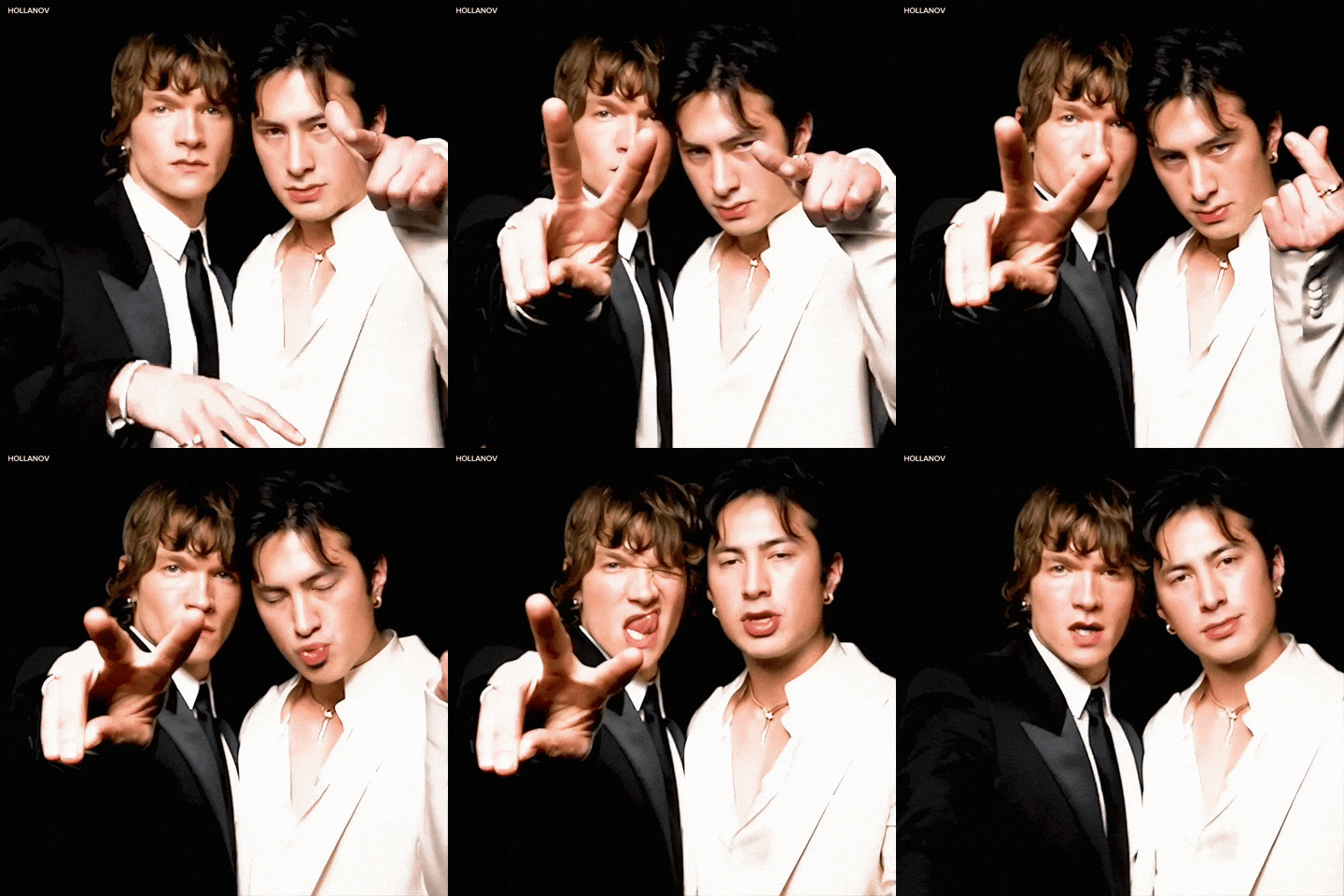
Heated Rivalry (HBO): I know, you’ve probably heard about it from a billion people by now. But there’s a good reason, I think. Critics keep trying to explain why it works (the chemistry between the leads is off the charts, the adaptation is reverent to the source material, it takes queer love seriously), but I think it's simpler than that. It's a story about people learning to be vulnerable with each other in a world that punishes vulnerability. And right now, that feels like something worth watching. Also, it’s beautifully shot and I just found out the actor who plays Ilya Rozanov (Connor Storrie) learned Russian in under two months for the role. Fair warning: it will wreck you emotionally, especially episode 5.
The Good Place (Netflix, or check your library): Maybe it’s all the 2016 nostalgia floating around, but this sweet show has been back on my radar lately. It’s kind of about an awful woman who dies, goes to heaven and tries to become a better person to avoid being found out. Except it's also a show about moral philosophy, what we owe each other, and whether people can actually change. It’s somehow about ethics but also one of the funniest, most emotionally devastating shows on TV. It takes seriously the question: if everything is broken and we're all complicit, what do we do? The answer it lands on isn't despair and it isn't individual purity—it's messier and more hopeful than that. Also, Ted Danson is perfect in it. A good watch when you need to remember that trying matters, even when (especially when) you keep failing.
Solarpunk is a such a good companion for our times. Sending you hugs, dear friend